The global energy and manufacturing is based on industrial assets like pipelines, storage tanks, and pressure vessels. Nevertheless, these assets are continuously subjected to internal and external corrosion, stress-corrosion cracking, and wear. Historically, the process of inspecting these buildings was costly because it required scaffolds, lengthy downtime, or technicians to enter confined areas that were dangerous.
This has been revolutionized by Robotic Crawlers of PAUT corrosion mapping and weld inspection. With the combination of the high-mobility robotic crawler inspection systems and Phased Array Ultrasonic Testing (PAUT), 100 percent volumetric inspections can now be conducted at a greater speed and with the utmost precision in industries. These sophisticated automated ultrasonic testing systems present a digital health roadmap of an asset that can be used to perform maintenance based on data without interrupting the production process.
What is Robotic PAUT Corrosion Mapping?
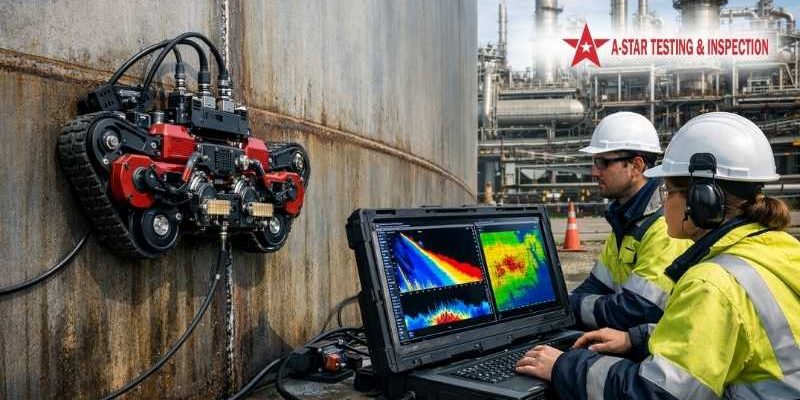
Remotely operated vehicles (ROVs) are robotic crawlers that are used to move across the surface of magnetic or non-magnetic surfaces (vertical tank walls and around curvy pipelines). These crawlers are fitted with PAUT sensors and are therefore the final diagnostic of the heavy industry.
PAUT (Phased Array Ultrasonic Testing) involves the use of a probe that has a few small ultrasonic elements. The beam may be steered and focused by electronically pulsing these elements at various times without actually moving the probe. As a robotic crawler scans this probe over a surface, it is:
- Digital Corrosion Mapping: Developing a color-coded high-resolution heat map of wall thickness.
- Weld Flaw Detection: This is done to detect cracks, unfused joints, and porosity in high-pressure joints.
- Automated Scanning: This is to assure 100% coverage, which can be lost by manual “point-to-point” UT measurement.
Key Applications of Robotic Crawler NDT
Robotic NDT technology offers a solution to complex geometries in the form of the huge networks of refinery piping to the huge vertically stacked storage tanks. They remove the use of scaffolding that requires a lot of space and labor, and hence, the systems have been installed in different environments in order to guarantee complete coverage of inspection. The main industrial uses of robotic PAUT crawlers, where they are the most effective in terms of safety and data quality, are stated below.
1. Oil & Gas Pipeline Integrity
Pipelines are also susceptible to internal corrosion as well as external corrosion by soil. Robot crawlers of PAUT corrosion mapping and welding inspection can scan long-range girth welds and long-seams of the pipeline. The system offers a digital record of the system that is permanent and can be compared on an annual basis to monitor the rates of corrosion.
2. Storage Tank Shell & Floor Inspection
ASTs are very large structures that are constructed above the ground. Manual inspection is a slow one and it tends to miss vast portions. Robots may be used to measure tank walls vertically by climbing up and down to scan the wall, and may be used to scan tank floors horizontally, crawling to detect localized thinning in order to meet API corrosion inspection codes such as API 653.
3. Pressure Vessel Volumetric Inspection
Extreme thermal stress is applied to pressure vessels in refineries. Robotic PAUT systems allow the detection of weld flaws on the exterior of the vessel and do not require hazardous internal access (Confined Space Entry) and are able to meet ASME ultrasonic testing requirements.
4. Offshore & Power Plant Maintenance
Since NDT inspection systems are safe, offshore platform legs (above the splash zone) can be inspected with a robotic NDT system, or in power plants with a high-pressure steam pipe, a robotic NDT system to reach high levels or other hazardous locations, where scaffolding would be prohibitively costly and unsafe.
Why Choose Automated PAUT Over Manual Methods?
The transition to robotic NDT inspection is driven by the need for better data and higher safety.
| Feature | Manual UT Inspection | Robotic PAUT Inspection |
| Coverage | Spot checks (limited) | 100% Surface mapping |
| Speed | Slow (Man-hours) | Rapid (Automated movement) |
| Data Quality | Subjective (Analog) | High-Resolution (Digital Imaging) |
| Safety | High risk (Working at height) | Low risk (Remote operation) |
| Traceability | Hand-written reports | Digital scan files (Auditable) |
The Robotic PAUT Workflow: Precision in Motion
- Deployment: A magnetic-wheeled crawler is placed on the asset (tank, pipe, or vessel).
- Coupling Management: The automated system offers a continuous stream of water or couplant between the PAUT probe and the metal surface to transmit a clear signal.
- Digital Acquisition: During the crawling process, the PAUT system gathers “C-Scan” data, which forms a plan-view representation of the interior structure of the material.
- Analysis: Certified inspectors analyze the scans with special programs to know the depth of corrosion, faults in welds, and degradation of materials.
- Reporting: The client will be provided with a complete report containing a fine-detailed corrosion map with precise measurements of all centimeters of the thickness of every square centimeter measured.
Standards and Safety Compliance
Your facility will be in compliance with the strictest safety organizations across the globe:
API 510 & 653: For the standardized inspection of vessels and storage tanks.
ASME Section V: Governing non-destructive examination procedures.
ISO Certified Procedures: Ensuring repeatability and quality in every scan.
FAQs: Robotic PAUT Inspection
Q1: Do robotic crawlers have the capability to scan non-magnetic surfaces?
Ans: Yes. Although most crawlers roll on magnetic wheels of steel tanks, we also have vacuum-suction crawlers or guided track systems of non-magnetic or stainless steel assets.
Q2: What is the speed of the inspection against manual UT?
Ans: Electronic Robotic PAUT can be 5 to 10 times faster than manual point to point thickness gauging, mainly due to the fact that it is a single pass scanner and it scans a broad strip of material.
Q3: How is a Digital Corrosion Map an advantage?
Ans: The corrosion pattern is reflected on a map (in contrast to a single number of thickness). This will assist the engineers in identifying whether it is a localized (pitting) or a widespread (general thinning) problem, which is important in Fitness-for-Service (FFS) assessments.
Q4: Are these crawlers able to operate underwater?
Ans: No. Our robotic crawler inspection systems are applicable to top side and onshore offshore assets. They must be used in dry and above-ground conditions.
Conclusion: The Future of Industrial Asset Integrity
Corrosion mapping and weld inspection, Robotic Crawlers are the state of the art of modern NDT in the industry of PAUT. These systems provide a degree of safety and accuracy not achievable before, since they eradicate barriers of access by humans and manual data collection.
Automated PAUT is the answer to avoiding downtime and ensuring as long as possible the life of your infrastructure, whether that infrastructure is a cross country pipeline or a refinery with a critical set of pressure vessels.
Get to know more about our robotic PAUT solutions and how they can bring the newest advancements into your maintenance approach and deliver complete asset integrity. Contact A-Star Testing & Inspection Today.